MIG Welding Robot Manufacturer in Pune – Weldarc India
MIG Welding Robot Manufacturer in Pune – Weldarc India
Introduction to MIG Welding Robots in Pune
The manufacturing industry is continuously adopting advanced technologies to improve productivity, maintain consistent quality, and reduce production time. Robotic welding has become an important solution for businesses that require accurate, repeatable, and efficient metal joining. A MIG welding robot is designed to automate welding operations and help manufacturers achieve reliable results across repetitive production tasks.
Weldarc India provides industrial welding and cutting automation solutions for businesses across India. As a manufacturer and supplier of industrial automation equipment, the company focuses on solutions that support manufacturing efficiency, operator safety, and consistent production quality. Businesses searching for a MIG Welding Robot Manufacturer Supplier in Pune can explore robotic welding solutions suitable for their component designs, production volumes, and operational requirements.
Pune is an important industrial centre with manufacturing activities in automotive components, engineering, fabrication, machinery, and industrial equipment. For companies operating in these sectors, robotic MIG welding can help improve production consistency while reducing dependence on repetitive manual welding operations.
What Is a MIG Welding Robot?
A MIG welding robot is an automated welding system that uses a programmable robotic arm to perform Metal Inert Gas (MIG) welding. The process is also commonly known as Gas Metal Arc Welding (GMAW). It uses a continuously fed consumable wire electrode and shielding gas to create a strong weld between compatible metal components.
Unlike conventional manual welding, a robotic system follows programmed movements, torch angles, and welding parameters. This makes it suitable for applications where similar components must be welded repeatedly with consistent results.
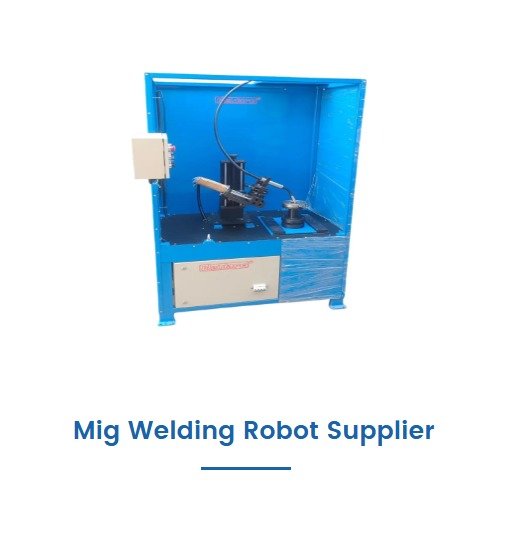
A typical robotic MIG welding system may include a robotic arm, MIG welding power source, wire feeder, welding torch, control unit, workholding fixture, safety equipment, and optional component-positioning equipment. The final configuration depends on the product design, material thickness, welding requirements, and production target.
MIG Welding Robot Manufacturer in Pune for Industrial Applications
Manufacturers in Pune often work with demanding production schedules and require dependable welding processes. A robotic MIG welding system can help businesses standardise repetitive welding tasks and improve control over production operations.
Weldarc India supports industrial customers with welding automation solutions designed around practical manufacturing requirements. Before selecting equipment, businesses should consider component dimensions, weld length, joint configuration, material type, cycle time, and the number of parts produced per shift.
The right system can be configured for applications ranging from simple repetitive joints to more complex fabrication assemblies. Proper integration of the robot, welding equipment, fixtures, and safety systems is essential for achieving reliable results.
Key Features of Robotic MIG Welding Systems
1. Consistent Welding Quality
Robotic welding follows a programmed path and controlled welding parameters. This helps minimise variations caused by repetitive manual movements and supports uniform weld appearance across similar components.
Actual weld quality depends on material preparation, joint fit-up, fixture accuracy, wire selection, shielding gas, and parameter settings.
2. Improved Production Efficiency
A robotic MIG welding system can automate repetitive welding tasks and reduce the time spent on manual torch positioning. When the robot, fixtures, and component-loading process are properly coordinated, manufacturers may improve throughput and achieve more predictable production cycles.
3. Programmable Welding Operations
Modern robotic systems can store programs for different components and welding sequences. This is useful for manufacturers producing multiple product models or handling recurring orders. Changeover time depends on the robot controls, fixture design, and complexity of the components.
4. Reduced Repetitive Manual Work
Automation can reduce the physical demands associated with repetitive welding operations. Operators can focus on component preparation, loading, inspection, supervision, and other production activities after receiving suitable training.
5. Better Process Control
A properly configured system allows manufacturers to control important welding variables, including travel speed, wire-feed speed, torch position, and welding current and voltage settings. Suitable monitoring equipment can further support process consistency.
6. Integration with Production Equipment
Robotic MIG welding can be integrated with jigs, fixtures, positioners, conveyors, and other automation equipment. The level of integration depends on the production layout, component handling method, and desired automation level.
Applications of MIG Welding Robots
Robotic MIG welding systems are used in many manufacturing and fabrication environments. Common applications include:
-
Automotive components: Welding brackets, frames, supports, and selected structural components.
-
Sheet metal fabrication: Joining fabricated metal parts and assemblies.
-
Industrial machinery: Welding machine frames, mounting structures, and equipment housings.
-
Structural fabrication: Joining compatible steel sections and fabricated assemblies.
-
Agricultural equipment: Manufacturing selected frames, supports, and machine components.
-
Material handling equipment: Welding trolleys, racks, and suitable handling structures.
-
Electrical enclosures: Joining compatible metal enclosure components.
-
General engineering: Repetitive welding operations involving standardised metal parts.
The suitability of robotic welding for any particular component should be established through technical evaluation and, where necessary, sample weld trials.
Benefits of Choosing a MIG Welding Robot for Your Pune Factory
Increased Productivity
Automating repetitive welding operations can help manufacturers maintain a more consistent production rhythm. Robots can follow programmed welding paths without the natural variation associated with manual torch movement.
The actual productivity improvement depends on loading time, component preparation, cycle time, and the efficiency of the complete production cell.
Reduced Rework and Material Waste
Consistent welding parameters and accurate positioning can help reduce defects caused by inconsistent execution. Fewer defects may reduce rework, scrap, and unnecessary consumption of welding wire and shielding gas. However, correct process development and quality inspection remain essential.
Improved Workplace Safety
Welding involves heat, ultraviolet radiation, fumes, and sparks. A properly designed robotic welding cell can use protective enclosures, interlocks, extraction systems, and other safeguards to separate personnel from welding hazards. Risk assessment and appropriate operator training are still necessary.
Better Production Planning
Automated processes can make cycle times more predictable, helping production teams plan workloads and schedules. Manufacturers can also monitor performance and identify bottlenecks in the overall production process.
Long-Term Operational Value
Although robotic welding requires an initial investment, it may deliver long-term benefits through improved consistency, reduced rework, better utilisation of labour, and higher production capacity. Businesses should assess total ownership costs, including installation, training, maintenance, consumables, and integration.
How to Select the Right MIG Welding Robot Manufacturer in Pune
Choosing a suitable robotic welding solution requires more than comparing equipment prices. Manufacturers should evaluate the supplier's technical capabilities and the suitability of the proposed system for their production needs.
Consider the following factors:
1. Application assessment: Confirm that the supplier understands your components, materials, weld joints, and production targets.
2. Robot specifications: Review working reach, payload, axes, positioning capability, and access to all required weld locations.
3. Welding equipment: Check the compatibility of the power source, wire feeder, torch, and consumables with the intended welding process.
4. Fixture and positioner design: Ensure that components can be held accurately and presented to the robot in the correct orientation.
5. Safety provisions: Confirm the availability of suitable guarding, interlocks, emergency stops, and fume extraction arrangements.
6. Programming and training: Ask about operator training, program development, maintenance instructions, and troubleshooting support.
7. After-sales service: Evaluate the availability of technical assistance, spare parts, preventive maintenance, and commissioning support.
8. Return on investment: Compare the expected production benefits with the complete installation and operating costs.
A detailed discussion with the automation supplier can help establish a realistic configuration rather than investing in unnecessary features or selecting equipment that does not meet production requirements.
Why Consider Weldarc India for Welding Automation?
Weldarc India, also known as Mansoori Weldarc India Pvt. Ltd., works in industrial cutting, welding, and automation solutions. Its product portfolio includes welding automation systems, robotic welding solutions, CNC plasma cutting machines, and fibre laser cutting equipment.
The company highlights customised solutions, technical support, and quality-focused manufacturing as important aspects of its approach. It serves customers across India, including businesses in industrial manufacturing and fabrication.
Companies in Pune can contact Weldarc India to discuss their welding automation requirements and determine whether a suitable MIG robotic welding configuration is available for their applications.
Every production environment has different needs. Therefore, the recommended system should be based on component geometry, material specifications, production volume, available floor space, and the desired level of automation.
Industries That Can Benefit from Robotic MIG Welding
Several industries can benefit from robotic welding when their products involve repeatable joints and sufficient production volume.
Automotive and auto-component manufacturers can use automation for recurring component assemblies. Heavy engineering companies may consider robotic welding for suitable fabricated structures. Sheet metal businesses can evaluate it for repeated enclosures and frames, while machinery manufacturers may use it for standardised supports and machine bases.
The technology can also be useful for manufacturers of agricultural equipment, industrial furniture, metal racks, and material-handling products.
However, robotic welding is not automatically the best choice for every application. Very low production volumes, frequent design changes, irregular components, and difficult joint access may require a different approach or a flexible automation setup.
Installation, Training, and Maintenance
Successful implementation involves more than installing a robotic arm. The production team must prepare suitable fixtures, establish welding parameters, validate the program, and check the quality of trial components before regular production begins.
Operator training should cover safe operation, program selection, basic fault identification, and daily inspection. Maintenance procedures should address the welding torch, contact tips, liners, cables, wire-feeding system, robot joints, and other components according to the manufacturer's recommendations.
Regular preventive maintenance can help reduce unexpected downtime and maintain consistent performance. Businesses should also establish a documented process for inspecting weld quality and reviewing production issues.
Get a MIG Welding Robot Solution for Your Pune Business
If your company is planning to automate repetitive welding operations, a robotic MIG welding system may help improve consistency, productivity, and workplace organisation.
Weldarc India can be contacted to discuss your component requirements, production goals, and welding automation needs. Before requesting a quotation, prepare details about the material grade, component drawings, weld locations, production quantity, and expected cycle time. These details help the technical team evaluate the application and recommend a suitable solution.
Contact Weldarc India to discuss MIG welding robot solutions for manufacturing and fabrication applications in Pune and other industrial locations across India.
Website: https://weldarcindia.com/
Business address: 23/7 Mathura Road, Near JCB India, Ballabgarh, Faridabad, Haryana 121004, India.
Email: info@weldarcindia.com
Frequently Asked Questions (FAQs)
1. What is a MIG welding robot?
A MIG welding robot is a programmable industrial robot equipped with welding equipment to join metal components using the Metal Inert Gas welding process. It is commonly used for repetitive welding applications that require consistent torch movement and controlled parameters.
2. Who supplies MIG welding robot solutions for Pune industries?
Weldarc India provides industrial welding and automation solutions and serves customers across India. Businesses in Pune can contact the company to discuss their application and confirm the availability of a suitable robotic MIG welding system.
3. What is the price of a MIG welding robot in Pune?
The price depends on the robot model, welding power source, working reach, fixtures, positioners, safety enclosure, software, and installation requirements. Request a customised quotation after sharing your component details and production targets.
4. Which materials can be welded using a robotic MIG welding system?
Depending on the selected welding equipment, wire, shielding gas, and procedure, robotic MIG welding can be used for suitable mild steel, stainless steel, and aluminium applications. Material compatibility should be confirmed for the specific job.
5. Can a MIG welding robot improve production efficiency?
Yes. It can improve consistency and reduce repetitive manual welding time. The actual improvement depends on component loading, cycle time, fixture design, welding parameters, and production planning.
6. Is robotic MIG welding suitable for small manufacturing businesses?
It can be suitable for small businesses when recurring production volumes and labour requirements justify the investment. A cost-benefit assessment should include equipment, integration, training, maintenance, and expected production savings.
7. Does a robotic welding system require skilled operators?
Yes. Operators and technicians need suitable training in safe operation, program selection, basic troubleshooting, and routine inspection. More complex systems may also require trained robot programmers and maintenance specialists.
8. Can a MIG welding robot weld different components?
Many systems can store multiple programs for different components. Changeovers may require new programs, fixtures, torch positions, and welding parameters. The flexibility depends on the system configuration and the range of components.
9. What information is required to select a robotic welding machine?
Important details include material type and thickness, component drawings, joint design, weld length, production volume, cycle-time targets, and available factory space. Sample components may also be required for testing.
10. Why should manufacturers consider welding automation?
Welding automation can support consistent weld quality, repeatable production, reduced repetitive manual work, and improved process control. The benefits depend on proper system selection, integration, operator training, and maintenance.
11. Does Weldarc India provide welding automation solutions beyond Pune?
Weldarc India states that it serves customers across India. Contact the company directly to confirm installation, commissioning, training, and service arrangements for your location.
